
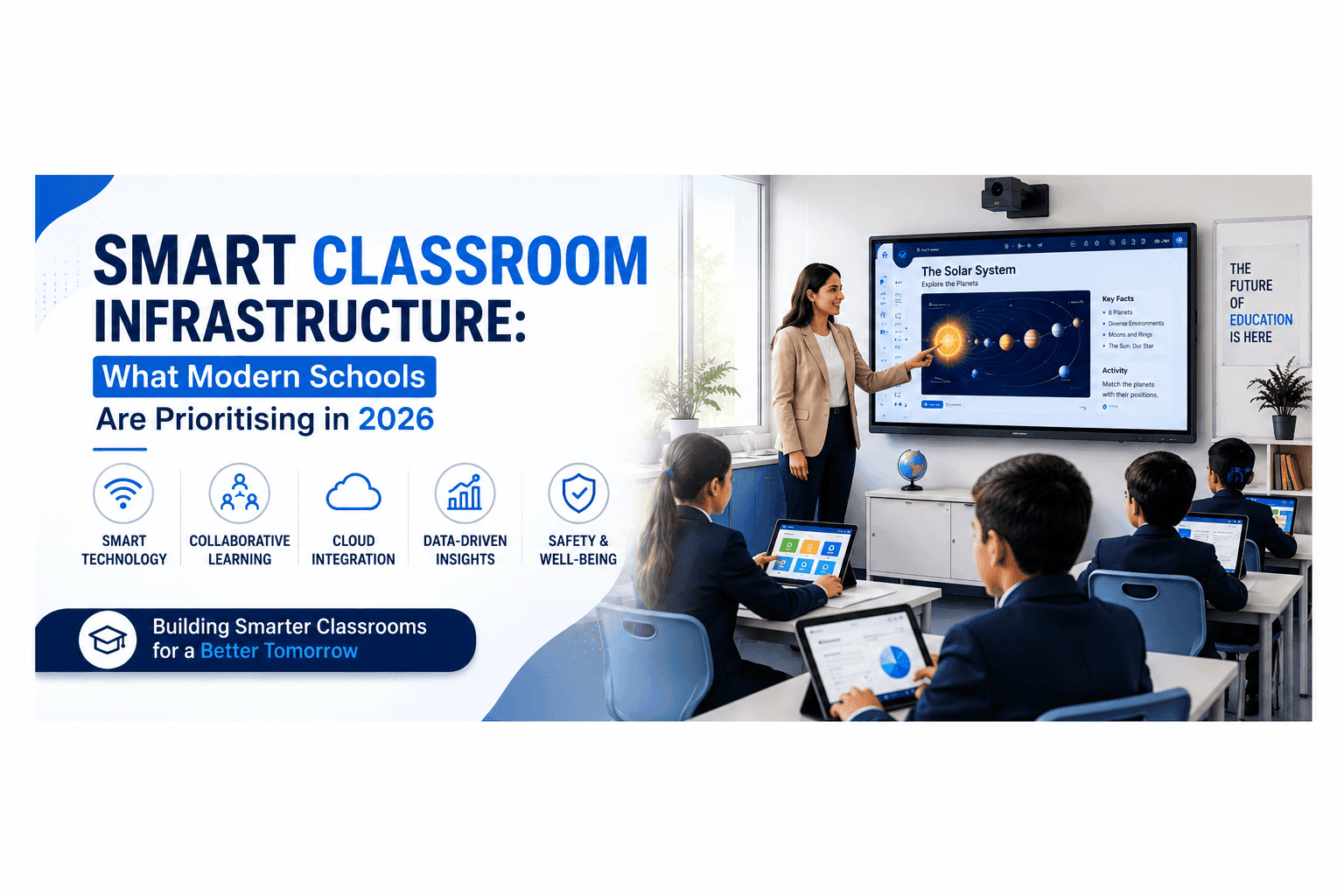
Smart Classroom Infrastructure:What Modern Schools Are Prioritising in 2026
Discover how smart classroom infrastructure is transforming education in 2026. Explore the technologies, flexible learning spaces, connectivity, and digital tools modern schools are prioritizing to improve student engagement and learning outcomes.
Over 250 million students study in Indian classrooms today yet fewer than 12% of those rooms are designed for the way children actually learn in 2026. Smart classroom infrastructure is no longer about adding a projector to a painted wall. It is a holistic rethinking of physical space, acoustic performance, technology integration, and student comfort and schools that get it right are seeing measurable improvements in attention, participation, and outcomes. This guide covers what modern Classroom schools are prioritising, why execution quality determines success, and how to plan a classroom upgrade that lasts a decade.
Key Takeaways
✔ | Flexible furniture layouts are replacing fixed seating in schools prioritising active learning. |
✔ | Acoustic treatment directly impacts student concentration — and is often overlooked in renovation plans. |
✔ | Technology infrastructure must be planned at the build stage, not added as an afterthought. |
✔ | Student wellness factors — natural light, ventilation, ergonomics — drive attentiveness as much as technology does. |
✔ | Execution quality and material durability determine long-term infrastructure performance. |
What Is Smart Classroom Infrastructure?
Smart classroom infrastructure is the integrated system of physical design elements, technology installations, furniture, acoustics, lighting, and network connectivity that together enable modern, student-centred education. It applies to any school or institution seeking to move beyond traditional lecture-format rooms toward spaces designed for interaction, collaboration, and technology-enabled learning.
According to UNESCO's 2025 Global Education Report, schools with purpose-designed learning environments record up to 22% higher student engagement scores compared to conventionally designed classrooms. Related entities central to this space include interactive flat panels, acoustic wall systems, modular seating, and structured cabling infrastructure.
Why the Definition of a Classroom Is Changing
Traditional classrooms were built around one-way teaching: a teacher at the front, students in fixed rows, attention directed at a single point. This model served mass education in the 20th century. It does not serve the competency-based, collaborative, and digitally integrated demands of education in 2026.
Modern classrooms are now being designed around five principles:
• Interaction — between students, and between students and content
• Collaboration — physical layouts that make group work natural
• Technology integration — infrastructure that supports, not fights, digital tools
• Flexibility — spaces that adapt to different lesson types
• Student engagement — environments that actively support attention and participation
This shift is reshaping educational infrastructure planning across India, where school renovation investment is projected to exceed ₹18,000 crore by 2027.
What Schools Are Prioritising Today
1. Flexible Furniture Layouts
Fixed seating systems bolted desks in rigid rows are being systematically replaced by adaptable furniture arrangements. Schools investing in modular, lightweight furniture report that teachers use an average of three distinct room configurations per day. Flexible layouts enable:
• Group discussions without moving furniture across the room
• Activity-based learning with clear floor space
• Collaborative project work in clusters
• Quick transitions between individual and group tasks
Furniture specification for smart classrooms should account for height-adjustability, stackability, and caster mobility not just aesthetic appeal.
2. Better Acoustic Performance
Poor acoustics are among the most underestimated obstacles to learning quality. A 2024 study by the International Journal of Educational Research found that students in rooms with reverberation times above 0.6 seconds scored 18% lower on comprehension tests than those in acoustically treated spaces.
Schools are increasingly investing in:
• Acoustic wall panels and fabric-wrapped baffles
• Noise-reduction ceiling tiles and suspended acoustic rafts
• Carpet or acoustic flooring in lieu of bare concrete
• Door seals and window glazing to reduce external noise intrusion
Acoustic treatment is now considered a non-negotiable element of smart classroom design — not an optional upgrade.
3. Integrated Technology Infrastructure
The most common and costly mistake in classroom modernisation is treating technology as a decoration layer applied over an unchanged room. Smart classrooms and School technology integration require technology to be planned at the infrastructure level, before any surface finishes are applied. This includes:
• Power planning dedicated circuits for displays, AV equipment, and charging banks
• Interactive flat panels or projection systems with appropriate throw distances
• Charging stations and USB power points built into furniture or floor boxes
• Structured cabling and Wi-Fi access point placement planned for full coverage
• Network readiness PoE switches, server room provision, and bandwidth planning
Schools that retrofit technology into rooms not designed for it spend 40–60% more over five years in maintenance, cable management, and equipment replacement costs.
4. Student Comfort and Wellness
Research in educational neuroscience consistently links physical environment quality with cognitive performance. Modern classroom design addresses:
• Natural lighting — windows positioned to avoid glare on screens while maximising daylight
• Ventilation — fresh air circulation rates above 5 litres per second per person
• Ergonomic furniture — seating and desk heights calibrated to student age groups
• Thermal comfort — passive and active systems that maintain 22–26°C year-round
These are not comfort luxuries. They are performance infrastructure. Schools in Delhi and other high-density urban areas are increasingly specifying thermal comfort systems as part of classroom renovation services in Delhi briefs not HVAC upgrades.
Traditional Classroom vs. Smart Classroom: Feature Comparison
Use this table to identify which infrastructure elements your school's classrooms are missing:
Feature | Traditional Classroom | Smart Classroom | Best For |
Seating | Fixed rows | Flexible/modular | Collaborative learning |
Display | Blackboard/whiteboard | Interactive panels | Active participation |
Acoustics | Bare walls | Treated surfaces | Focus & comprehension |
Lighting | Fluorescent fixed | Natural + adaptive | Student wellbeing |
Technology | Projector add-on | Integrated infra | Seamless delivery |
Network | None or basic | Full Wi-Fi + PoE | Digital curriculum |
"Schools that invest in infrastructure quality — not just technology quantity — are the ones seeing lasting improvements in student outcomes. A well-designed classroom is a pedagogical tool in itself." —Director of School Infrastructure |
How to Plan a Smart Classroom Infrastructure Upgrade: Step-by-Step
Step 1 — Audit Your Existing Infrastructure
Before specifying any new equipment or furniture, conduct a room-by-room audit. Document current seating capacity, natural light levels, acoustic performance (echo test), power point locations, and network connectivity. This baseline prevents over-specification and reveals quick wins.
Step 2 — Define the Pedagogical Brief
Infrastructure should serve teaching method, not the reverse. Work with teachers and academic leadership to identify which learning formats the room must support — lecture, group work, project-based learning, hybrid, or a mix. This determines furniture type, display positioning, and acoustic requirements.
Step 3 — Prioritise Infrastructure Over Devices
Devices depreciate. Infrastructure lasts. Invest first in structural elements: acoustic treatment, electrical planning, network cabling, and lighting. Technology — panels, projectors, charging stations — should be specified once the infrastructure layer is confirmed.
Step 4 — Select Execution-Focused Partners
The quality gap in school infrastructure projects is almost always at execution, not design. Prioritise renovation partners with demonstrated experience in educational environments, durable material specifications, and post-completion maintenance commitments. Ask for references from similar school projects.
Step 5 — Phase the Rollout
Large-scale classroom upgrades need not happen all at once. Pilot one or two classrooms first, measure outcomes over one academic term, gather teacher and student feedback, and refine the specification before full-scale rollout. This approach reduces risk and builds internal buy-in.
Why Execution Quality Determines Infrastructure Performance
Even the most thoughtfully designed smart classroom will underperform if execution quality is poor. Educational infrastructure projects are subject to unique stresses: high daily usage, varying humidity and temperature in Indian climates, and limited maintenance windows.
Execution quality requirements include:
• Durable surface materials rated for high-traffic educational use
• Safe electrical detailing — concealed conduits, protected sockets, appropriate MCB ratings
• Reliable, certified electrical systems with appropriate load calculations
• Acoustic products specified and installed per manufacturer tolerances
• Long-term maintainability — components that can be individually replaced, not whole-system overhauls
Schools increasingly prefer execution-focused renovation partners over design-only consultants, because infrastructure performance across a 10-year asset life matters far more than the visual appeal of a launch day.
Conclusion
The future ready classroom is not simply digital. It is flexible, student-centred, acoustically sound, well-lit, and operationally efficient built to perform across thousands of school days, not just look impressive in a renovation photograph. Smart classroom infrastructure is a strategic investment: schools that upgrade thoughtfully today are building the learning environments their students will rely on for the next decade.
For further reading, explore related guides on school acoustics planning, interactive panel selection, and educational furniture procurement.
FAQ.
Smart classroom infrastructure refers to the integrated combination of physical design, technology systems, furniture, acoustics, and network connectivity that enables modern, student-centred learning. It covers everything from interactive displays and Wi-Fi planning to ergonomic seating and acoustic treatment designed to support interaction, flexibility, and engagement.
Still have questions? Contact our team