
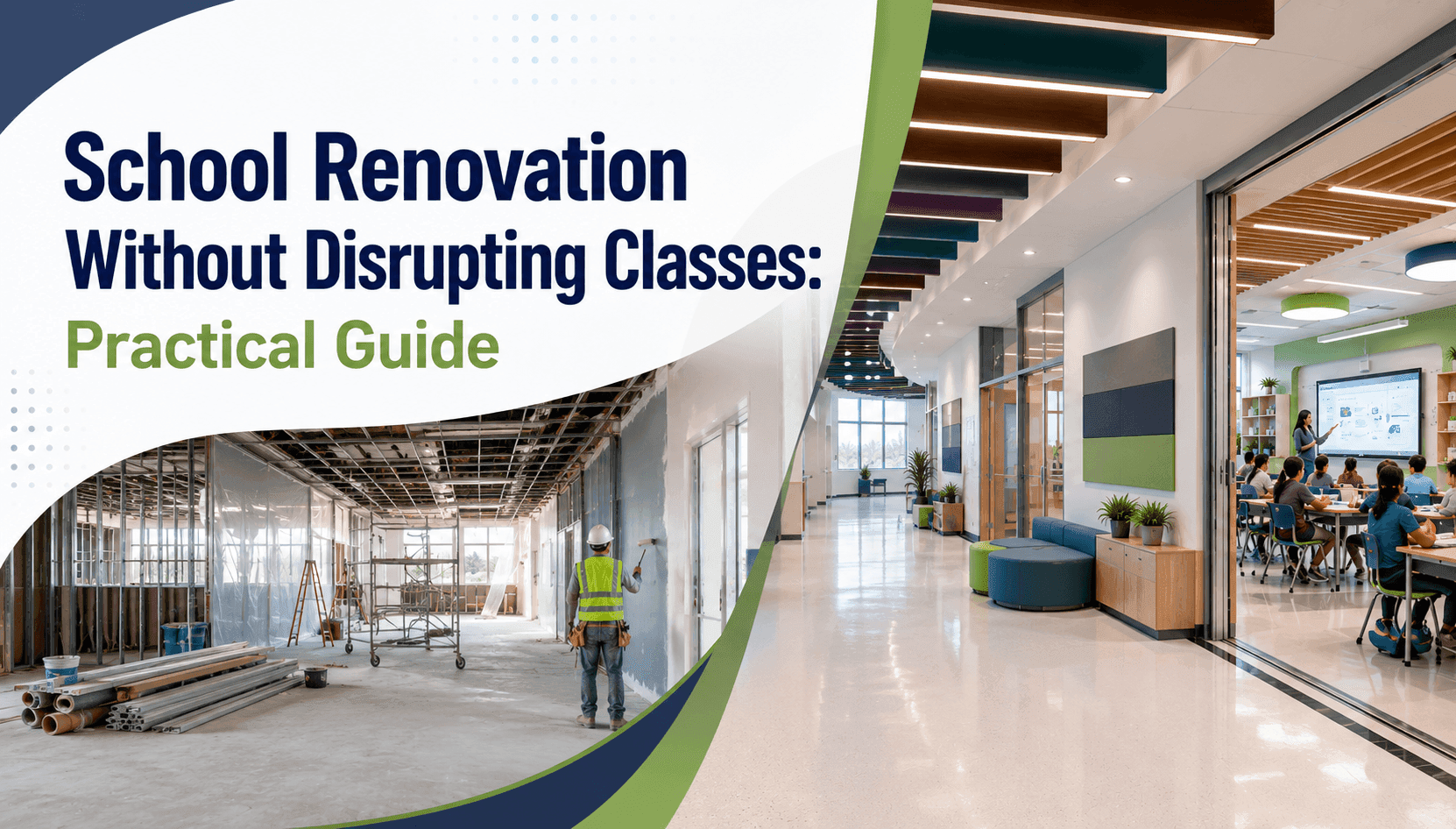
School Renovation Without Disrupting Classes: Practical Guide
A practical guide to planning school renovations safely and efficiently, minimizing classroom disruption while keeping projects on time and learning on track.
Walk into any thriving school today and you will notice something beyond academic excellence the physical environment itself teaches. Light, acoustics, layout, and technology are no longer background details. They are active ingredients in how students learn, how teachers perform, and how parents choose institutions.
Yet most schools across India are still operating in infrastructure built for a different era. Traditional classroom rows, outdated laboratories, poorly lit corridors, and furniture that has outlived two generations of students. The gap between where schools are and where modern education demands they be has never been wider.
The challenge, however, is not awareness. Every principal knows the classrooms need upgrading. The real challenge is execution specifically, how do you renovate an active school without turning the academic calendar into collateral damage?
"Renovation planning matters more than renovation itself. A beautiful design proposal means nothing without disciplined, live-campus execution capability."
Why renovation projects become stressful
Most renovation disasters happen not because of bad design, but because educational institutes are treated like ordinary construction sites. They are not. Schools operate within rigid constraints that no construction timeline can simply override.
Fixed examination schedules, daily student movement across the campus, parent expectations around safety and noise, and strict academic calendars all mean that a delay of even one week can cascade into a semester-wide problem. Add vendor coordination failures and unclear project scope, and you have the recipe for a renovation that costs twice the budget and delivers half the result.
Understanding this uniqueness is the first requirement of any serious school renovation . Execution systems matter far more than mood boards.
What schools are upgrading today
Educational institutes that are investing smartly are focusing on four key areas:
Smart classrooms
Interactive teaching infrastructure, Smart Classroom Infrastructure ,acoustic improvements, flexible seating, and integrated technology provisions shifting from "beautiful" to "high-performance."
STEM & innovation labs
Robotics zones, innovation spaces, and collaborative environments with specialized electrical, flooring, storage, and ventilation integration.
Libraries as collaboration hubs
Silent reading rooms evolving into hybrid learning environments with discussion areas, digital research zones, and acoustic-controlled lounges.
Auditoriums & multipurpose halls
Acoustic treatment, lighting upgrades, seating optimization, and AV infrastructure modernization for performance and seminar use.
Each of these spaces requires not just design thinking, but infrastructure integration expertise particularly for STEM labs where electrical systems, ventilation, and modular furniture must all work in concert.
The phased renovation strategy
The single most effective tool in school renovation planning is a phased execution strategy. Rather than attempting full-campus transformation simultaneously which creates chaos, safety risks, and enormous timeline pressure a phased approach divides the project into manageable, sequenced stages.
This can take several forms depending on the school's structure and academic calendar:
Summer vacation execution— the primary window for heavy civil work, flooring, electrical, and furniture installation without any student presence.
Floor-wise or block-wise renovation— isolating one section of the building at a time so learning continues uninterrupted in adjacent areas.
Night-shift and weekend work— for schools where operational pressure allows no extended downtime, contractors work after hours with tight site management.
Zone-based scheduling— mapping each renovation phase to examination-free academic windows to eliminate scheduling conflicts.
Decant and restore— temporarily relocating classes, then restoring spaces before the next academic segment begins.
This approach does not just protect academic continuity. It also reduces stress on staff, minimizes parent complaints, and typically improves quality control by allowing supervisors to focus on one section at a time.
Budget planning: durability over aesthetics
Many institutions begin the renovation conversation focused almost entirely on visual transformation — mood boards, color schemes, furniture catalogues. These are not unimportant. But they are the last conversation, not the first.
Institutional renovation is a long-term operational investment. A school building must perform reliably for a decade or more between major renovations. That means the real budget conversation centers on material durability, maintenance costs, execution feasibility, and future adaptability not on which shade of blue the walls should be.
Schools that approach renovation this way consistently report better value from their spend and far fewer post-project surprises. Those that prioritize visual impact often find themselves revisiting problems within three to five years.
Choosing the right renovation partner
Not every construction firm is equipped for live-campus institutional work. Evaluating a school renovation company in India requires going beyond portfolio images and asking sharper questions about execution capability.
Documented institutional project experience, not just residential or commercial
Clear systems for timeline management and milestone tracking
Demonstrated live-environment working protocols, including safety and noise management
Vendor management structure that prevents single-point failures
Post-project support commitments, not just handover documentation
Turnkey Institutional Interiors managing both design and execution under one accountability
The right partner reduces risk far more than they reduce cost. A cheaper bid that delays academic operations by three weeks is never a bargain.
Modern educational infrastructure does more than house students it signals institutional quality to every parent, faculty member, and prospective admission. Schools that invest in systematic, well-executed renovation consistently see improvements in faculty satisfaction, student engagement, and institutional reputation.
The goal is not a beautiful campus. The goal is a reliable, functional, future-ready learning environment built without disrupting a single class. That requires not just vision, but planning discipline and the right execution partner.
FAQ.
Timelines vary significantly by scope, but phased execution strategies allow schools to complete major upgrades without affecting academic schedules. Most single-block projects complete within one to two summer vacation cycles.
Still have questions? Contact our team