
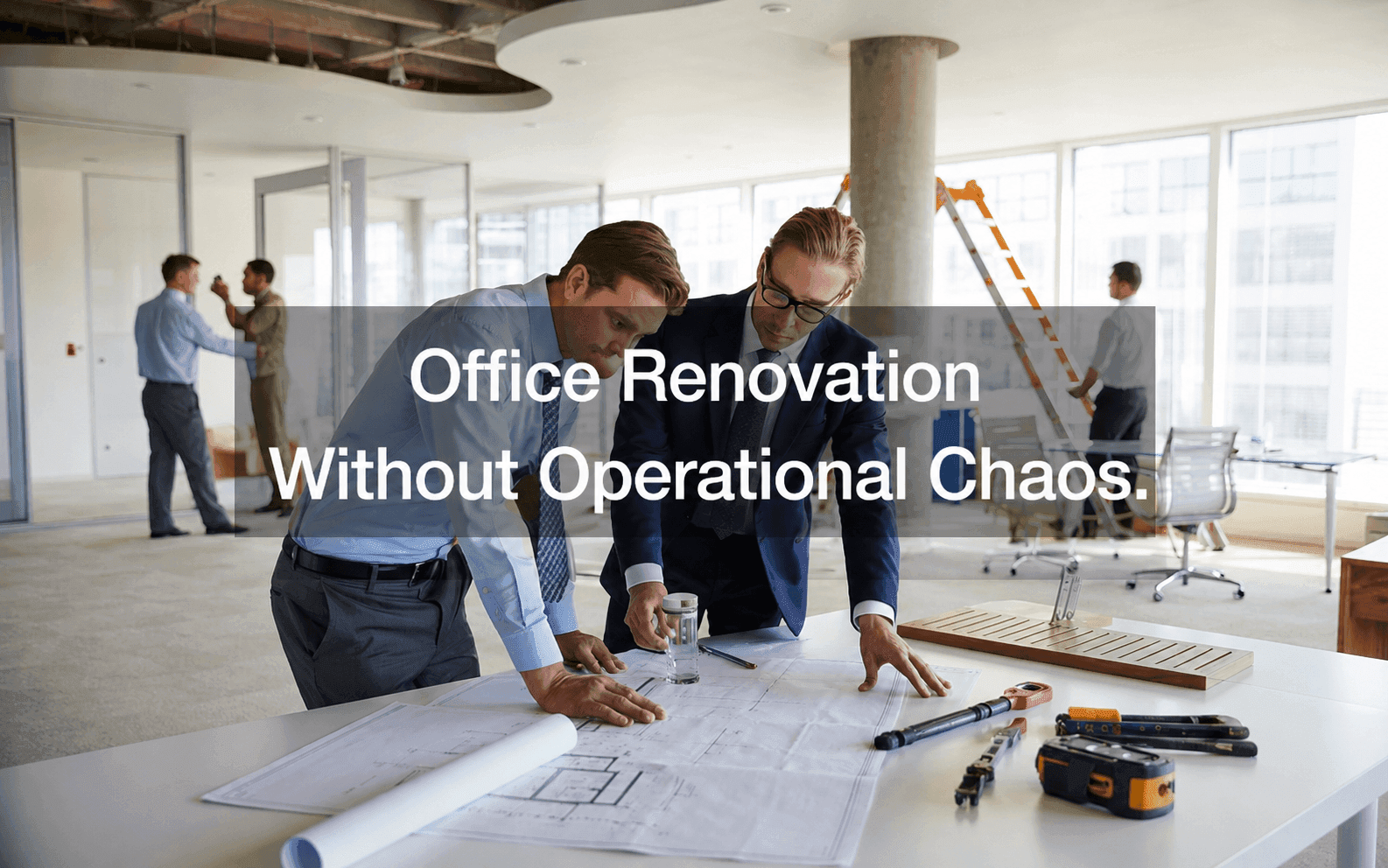
Office Renovation Without Operational Chaos:What Corporate Teams Should Know Before Starting
Plan your office renovation strategically to minimize disruptions, maintain productivity, and ensure business continuity. Learn key steps, timelines, communication strategies, and workspace solutions before starting your project.
Your Office Is Sending a Message Is It the Right One?
Walk into any high-performing company's office today and you will feel the difference before you even sit down.
The layout, the lighting, the spaces people move through all of it communicates something. It tells employees whether they are valued. It tells clients whether the company is serious. It tells recruits whether this is a place worth joining.
Office spaces today are far more than workplaces. They directly influence:
-
Employee productivity and focus
-
Talent retention and recruitment
-
Collaboration across teams
-
Brand perception with clients and partners
-
Workplace culture and morale
As hybrid work models continue to evolve, organizations across India are redesigning their offices to support flexibility, collaboration, and a stronger employee experience.
But here is where most companies run into trouble.
The renovation itself becomes a source of operational chaos disrupting the very productivity it was meant to improve. This guide is for corporate teams who want to avoid that outcome.
Why Office Renovation Has Become a Strategic Business Decision
Not long ago, office renovation was treated as a facilities decision. Repaint the walls, replace the furniture, maybe update the reception area.
That thinking has changed.
Today, office renovation is a strategic business decision one that sits at the intersection of HR, operations, real estate, and brand strategy.
Here is why:
Hybrid work has changed how offices are used. Employees no longer come in every day. When they do come in, they expect the office to offer something their home setup cannot collaboration, energy, connection, and focus zones.
Competition for talent is intense. The physical workspace plays a real role in whether top candidates accept offers and whether existing employees choose to stay.
Client perception matters. For businesses that host clients, partners, or investors, the office environment is a direct reflection of company standards.
A poorly planned office outdated, overcrowded, or misaligned with how people actually work actively works against business goals. Renovation, done correctly, corrects that.
The Real Fears Corporate Leadership Has About Renovation
When senior leadership hears the word "renovation," design is rarely the first concern.
The real concerns are operational:
-
Business disruption — Will we lose productive working days?
-
Employee inconvenience — Will noise, dust, and restricted movement frustrate our teams?
-
Timeline overruns — Will this stretch from 8 weeks to 6 months?
-
Cost escalation — Will the final bill look nothing like the original estimate?
-
Vendor coordination failures — Will multiple contractors create confusion and delays?
-
Productivity loss — Will the disruption cost us more than the renovation is worth?
These concerns are not unfounded. They are the lived experience of many organizations that have attempted renovation without adequate planning.
Understanding these fears upfront is the first step toward addressing them systematically.
Renovation Is an Operational Exercise, Not Just a Design Activity
This is the mindset shift that separates successful office renovation projects from chaotic ones.
Design is important. But design is the beginning of the process, not the whole of it.
A successful office renovation project depends on:
-
Detailed pre-execution planning — scope, sequence, timelines, dependencies
-
Execution sequencing — which areas are touched when, and in what order
-
Coordination systems — how multiple vendors communicate and align
-
Site management — daily supervision to catch problems before they escalate
-
Communication protocols — keeping employees, HR, and leadership informed throughout
This becomes especially critical in live office environments where work continues during renovation.
Without operational discipline, even a well-designed renovation plan will fail in execution.
Common Office Renovation Mistakes Corporate Teams Make
Understanding what goes wrong is as valuable as knowing what to do right.
1. Setting Unrealistic Timelines
It is tempting to compress timelines leadership wants minimal disruption, so the instinct is to push for faster delivery.
But aggressive deadlines that ignore execution realities lead to:
-
Poor finishing quality due to rushed work
-
Coordination breakdowns between trades
-
Last-minute firefighting that increases costs
-
Incomplete handovers that require follow-up work
Realistic timelines, built from a bottoms-up understanding of the actual work involved, are essential. A good execution partner will push back on unrealistic expectations — not accommodate them blindly.
2. Starting Execution Without Final Decisions
One of the most damaging patterns in office renovation is beginning physical work before all key decisions are finalized.
When design changes happen mid-execution:
-
Completed work gets undone and redone
-
Material orders are cancelled and reordered
-
Timelines slip and costs increase
-
Contractors lose confidence in the project direction
Decision clarity before execution is not a luxury it is a cost and timeline control mechanism. Every change order mid-project is a delay in disguise.
3. Ignoring Employee Experience During Renovation
Employees are not passive observers of a renovation. They are living through it.
Noise, dust, restricted access, and confusion about temporary workspace arrangements create daily frustration. Over weeks, that frustration affects morale, focus, and even attrition.
Professional renovation planning accounts for employee experience systematically:
-
Clear communication about phasing and timelines
-
Designated alternate work areas during disruption
-
Noise and dust containment measures
-
Regular updates to employees and department heads
Renovation that ignores people is renovation that creates new problems while solving old ones.
What Smart Companies Are Doing Differently
Organizations that execute successful renovations are not necessarily working with bigger budgets. They are working with better systems.
Phased Execution Planning
Rather than shutting down an entire floor or building, progressive companies renovate in phases:
-
Floor by floor — one floor is renovated while others remain operational
-
Department by department — teams rotate out during their section's renovation
-
Weekend and off-hours execution — heavy, disruptive work is scheduled outside working hours
-
Parallel workstreams — multiple non-conflicting areas progress simultaneously
This approach protects business continuity and gives employees a clear, predictable experience.
Flexible Workspace Planning
Modern office renovations are not about adding more desks. They are about creating spaces that support the way work actually happens today.
That means designing for:
-
Collaboration zones — open team areas that encourage interaction
-
Quiet focus zones — spaces for deep, individual work
-
Hybrid meeting rooms — equipped for both in-person and remote participants
-
Flexible seating — adaptable to different team sizes and work modes
-
Multi-functional spaces — areas that serve different purposes at different times of day
Efficiency and adaptability are becoming more important than elaborate aesthetics.
Focus on Long-Term Operational Value
Smart renovation decisions prioritize outcomes that last:
-
Durability — materials and finishes that hold up over years of use
-
Maintenance efficiency — systems that are easy and affordable to service
-
Adaptability — layouts that can evolve as the organization grows or changes
-
Employee comfort — ergonomics, acoustics, air quality, and lighting
-
Infrastructure scalability — electrical, data, and HVAC systems that support future needs
A renovation that looks impressive on day one but requires constant maintenance or cannot support organizational growth is a renovation that has failed its real purpose.
[Internal Link: Workspace Productivity Design]
Why Turnkey Execution Matters in Corporate Renovation
Corporate office renovation involves multiple specialized workstreams running simultaneously:
-
Civil and structural work
-
Electrical systems and load planning
-
HVAC design and installation
-
Furniture sourcing and integration
-
IT infrastructure and cable management
-
Finishing, flooring, and millwork
Each of these involves different vendors, different lead times, different site requirements, and different coordination dependencies.
Without centralized coordination, this complexity becomes very difficult to manage. Delays in one workstream cascade into others. Accountability becomes unclear. Clients end up managing contractors instead of running their businesses.
Turnkey execution models solve this problem directly.
A turnkey office renovation partner takes on centralized responsibility for the entire project — planning, procurement, coordination, supervision, and delivery. The client gets a single point of accountability instead of a fragmented web of vendor relationships.
This model significantly improves:
-
Coordination efficiency across trades and workstreams
-
Timeline adherence through integrated planning
-
Cost control through consolidated procurement and scope management
-
Quality consistency through unified site supervision
For corporate teams with limited bandwidth to manage renovation complexity, turnkey execution is not just convenient it is often the difference between a project that delivers and one that drains.
[Internal Link: Turnkey Interior Solutions]
How to Choose the Right Office Renovation Partner
The renovation partner you choose will determine your project's outcome more than almost any other factor.
Here is what to evaluate — beyond the portfolio presentation:
Corporate project experience — Have they executed projects of similar scale and complexity? Ask for specific examples.
Execution systems — Do they have documented processes for planning, sequencing, and site management? Or do they figure it out as they go?
Timeline management track record — Have their past projects completed on schedule? Ask clients directly.
Communication processes — How do they keep you informed? Daily site reports? Weekly reviews? Who is your point of contact?
Operational planning capability — Do they understand how to work in live office environments without disrupting operations?
Site supervision structure — Is there dedicated, experienced supervision on-site throughout the project? Or does a project manager visit occasionally?
The best renovation partner is not the one with the most glamorous portfolio presentation.
It is the one with the systems, experience, and operational discipline to deliver defined outcomes reliably on time, within budget, with minimal disruption to your business.
Conclusion: Smooth Renovation Is a Planning Problem, Not a Design Problem
The difference between a renovation that energizes an organization and one that exhausts it is not the design brief.
It is the planning, the process, the coordination, and the execution discipline behind it.
Successful office renovation projects share common traits:
-
Decisions finalized before execution begins
-
Realistic timelines built from ground-up planning
-
Phased execution that protects business continuity
-
Strong site supervision and communication
-
A partner with the systems to deliver, not just the portfolio to impress
Design creates the vision. Execution delivers it. And operational planning is what makes the journey from one to the other something your team can navigate without losing their minds.
Ready to Start Your Office Renovation the Right Way?
Planning an office renovation project in Delhi NCR?
Habitat Design and Arts helps organizations execute office renovations with realistic timelines, operational planning, and complete turnkey project coordination so your business keeps running while your workspace transforms.
FAQ.
Yes, it can — but it requires careful phased planning and execution control. Low-disruption tasks such as millwork, painting in isolated zones, and furniture installation can typically occur during business hours. High-noise or high-dust activities such as demolition and civil work should be scheduled for evenings or weekends. A well-structured renovation plan will map this out in advance.
Still have questions? Contact our team