
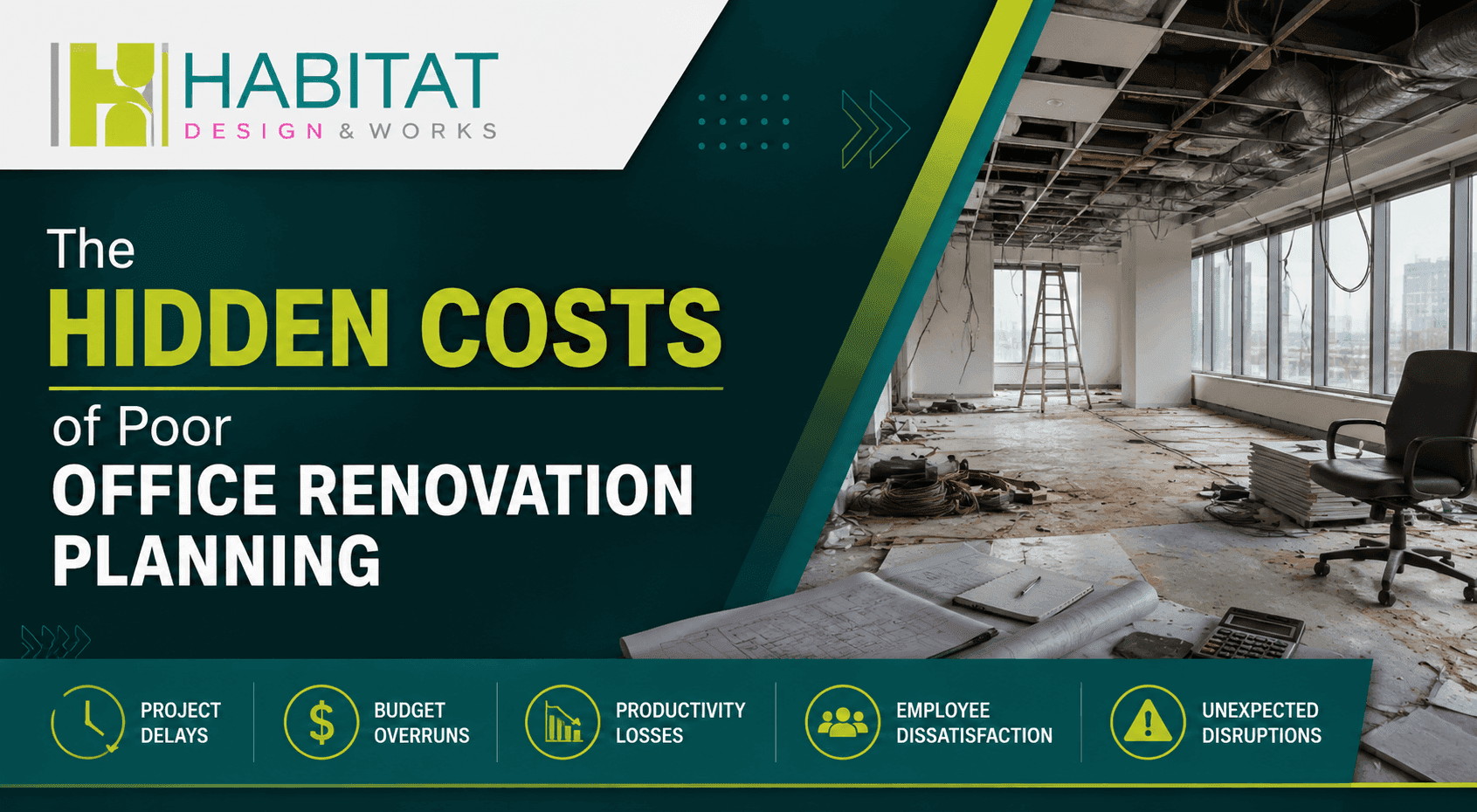
The Hidden Costs of Poor Office Renovation Planning
Poor office renovation planning can lead to budget overruns, delays, lower productivity, and design issues. Proper planning helps save time, money, and ensures an efficient, functional workplace
When an office renovation overshoots its budget or stretches past its deadline, the first instinct is usually to point fingers at contractors, vendors, labor shortages, or material delays. These are easy, visible culprits. But in most cases, the real damage was already done weeks before a single wall was opened or a single chair was moved.
Poor office renovation planning creates operational chaos long before site execution ever begins. By the time problems become visible on the floor, the underlying cause is almost always a planning gap that nobody addressed early enough. Understanding where these hidden costs originate is the first step toward avoiding them.
Most Office Renovation Problems Start Before Execution
Execution teams get blamed for delays that planning teams created. A site team can only work as efficiently as the brief, drawings, approvals, and procurement schedule allow them to. If scope is unclear, if budgets are approved without contingency, or if decision-making authority isn't defined, the project is already carrying risk before demolition starts.
This is why commercial renovation management has to begin well before the renovation itself with a realistic assessment of operational constraints, budget boundaries, and timeline expectations. Organizations that treat planning as a formality, rather than a discipline, tend to discover the cost of that shortcut much later, usually in the form of change orders and missed deadlines.
Hidden Cost #1 — Frequent Design Changes
Mid-project design modifications are one of the most consistent causes of budget escalation in office renovation. A change that looks minor on paper moving a partition wall, swapping a flooring material, adding a meeting pod rarely stays minor once it touches the execution sequence.
Every design change affects:
Procurement, since materials already ordered may need to be replaced or returned
Coordination, since multiple trades may need to resequence their work
Timelines, since approvals and lead times restart for the revised scope
Labor sequencing, since teams working in parallel now have to wait or rework completed sections
The cost of a late-stage change is rarely just the cost of the new material. It's the ripple effect across every team that had already planned around the original scope. This is one of the most common office renovation mistakes, and it's almost entirely preventable with a properly frozen design before execution begins.
Hidden Cost #2 — Business Disruption During Renovation
Renovation doesn't just affect physical space it affects how a business actually functions while the work is happening. Without a phased plan, the disruption to daily operations can end up costing more than the construction itself.
Common operational impacts include:
Reduced employee productivity due to noise, dust, or relocated workstations
Disrupted client meetings when reception or conference areas are mid-renovation
Breakdown in team coordination when departments are split across temporary locations
Lower workplace morale when timelines feel unpredictable or communication is inconsistent
A well-planned workspace renovation sequences work zone by zone, so teams know exactly when their area will be affected and for how long. This kind of predictability is what separates renovation that supports business continuity from renovation that quietly drains productivity for months.
Hidden Cost #3 — Delayed Decision-Making
Many renovation projects don't slow down because of construction problems — they slow down because nobody was empowered to make a timely decision. Approval bottlenecks are one of the quieter but more expensive forms of project delay.
These delays typically show up around:
Material selection, when multiple stakeholders need to align on samples
Vendor confirmation, when procurement is waiting on sign-off
Budget approvals, when costs need escalation through layers of management
Design sign-offs, when feedback comes in piecemeal rather than as a single decision
Fast execution depends on fast decision systems. Institutions and corporates that designate a single point of authority or a small, empowered decision-making group consistently move faster than those routing every approval through a broader committee.
Hidden Cost #4 — Unrealistic Timelines
An aggressive deadline can feel like a way to control cost and disruption, but unrealistic timelines often produce the opposite result. When schedules are compressed beyond what the scope actually allows, the pressure shows up in the quality of the work.
The typical consequences include:
Poor workmanship from teams rushing to hit dates
Rework that extends the timeline further than a realistic schedule would have
Quality compromises that surface only after the team has moved on
Burnout among site teams managing parallel trades under pressure
Reliable turnkey office interiors execution depends on scheduling that reflects real-world sequencing — civil work before electrical, electrical before finishing, finishing before furniture and technology setup. Timelines built around wishful thinking tend to cost more than timelines built around experience.
Hidden Cost #5 — Poor Coordination Between Vendors
Office renovation is rarely a single-trade project. It typically involves civil work, electrical systems, HVAC, furniture, and technology infrastructure each managed by a different specialist, often from different vendors.
Without centralized coordination, inefficiencies compound quickly. An electrician may need to wait on civil work that's running behind. Furniture may arrive before flooring is finished. IT infrastructure may need to be installed before false ceilings close off access points and if that sequence is missed, walls or ceilings may need to be reopened.
This is where a centralized execution partner becomes valuable not as an additional layer of management, but as the single point accountable for sequencing every trade correctly. Projects with fragmented vendor management are far more likely to experience cost overruns and missed deadlines than those run under one coordinated execution plan.
How Smart Organizations Avoid These Problems
Organizations that consistently achieve smoother renovation outcomes tend to follow a similar pattern, regardless of project size or industry:
They freeze design scope early and resist late-stage changes unless absolutely necessary
They use phased execution, so operations continue with minimal interruption
They appoint a single point of centralized project coordination across all vendors and trades
They prioritize operational continuity as a planning input, not an afterthought
They invest time in office renovation planning before demolition begins, rather than treating planning as a delay to execution
None of this requires a larger budget. It requires execution discipline the kind that comes from having managed institutional and corporate renovation projects enough times to know where things typically go wrong, and planning around those failure points in advance.
Final Thoughts
Office renovation should improve how a workplace functions not introduce avoidable stress, budget anxiety, or operational disruption along the way. The organizations that get this right aren't necessarily the ones with the biggest budgets or the most ambitious designs. They're the ones that invest seriously in planning, sequencing, and coordination before the first wall comes down.
A renovation project is, at its core, a logistics and decision-making exercise as much as a design one. Treating it that way with realistic timelines, frozen scope, centralized coordination, and clear approval authority is what separates renovations that run smoothly from those that quietly cost far more than anyone expected.
"Planning an office renovation and want to avoid the cost and disruption that comes with poor execution planning? Talk to Habitat Delhi about a phased, coordinated renovation approach built around your operational timelines."
FAQ.
Mid-project design changes are typically the most expensive hidden cost, since they affect procurement, labor sequencing, and coordination across multiple trades simultaneously — not just the cost of the new material itself.
Still have questions? Contact our team